How to answer “Tell Me About Yourself” in an Interview
Among all the questions you’ll face in a technical interview—whiteboard coding, debugging, system design—none lands with more anxiety than How to answer “Tell Me About Yourself” in an interview. It may sound like an icebreaker, but in reality, it’s the most pivotal question you’ll answer. Research shows that nearly half of hiring managers are influenced by your answer within the first five minutes, and this opening sets the tone for every subsequent discussion.
In the competitive tech landscape—where highly qualified candidates are a given—your response not only demonstrates your technical competencies, but also your communication skills, self-awareness, and alignment with the role and company culture. The right answer signals to the interviewer that you’re not just technically strong, but self-driven, collaborative, and ready to add value on day one.
In this blog, we’ll dive deep into:
Structuring an effective “Tell Me About Yourself” answer for technical roles
Balancing personal and professional elements
Using the STAR method and storytelling frameworks to stand out
Common mistakes to avoid (with examples)
How to quantify your impact with achievements and metrics
Real examples tailored for junior and experienced tech professionals
How SynergisticIT propels job seekers to interview success with targeted resources, industry expertise, and hands-on support
Let’s break down a framework that can transform this dreaded opener into your secret weapon for acing tech interviews.
Understanding Interviewers’ Intent: What Are They Really Looking For?
“Tell me about yourself” isn’t small talk. It’s a diagnostic tool. Interviewers ask it to assess:
Your communication skills: Can you explain complex ideas clearly and concisely?
Self-awareness and relevance: Do you know what’s most important to the role?
Your professional narrative: Can you connect your experience to company needs?
Confidence and presence: How do you handle open-ended questions under pressure?
Cultural fit and motivation: Are you here for the long term, and do our missions align?
A strong answer reassures the interviewer that you have the relevant skills, know your strengths, and are genuinely excited about their role—not just any tech job.
Structuring Your Answer: The Present-Past-Future Formula
The backbone of a compelling introduction is the Present-Past-Future framework. Nearly every expert source, from The Interview Guys to Big Interview and Career Sidekick, agrees: This structure ensures your answer is logical, concise, and relevant.
Step 1: Present – Where You Are Now
Start with your current role and responsibilities or, if you’re a recent graduate, your academic and technical background.
“I’m a backend software engineer at FinTech Solutions, where I design and optimize distributed payment systems handling over one million transactions daily…”
Step 2: Past – Key Experiences & Technical Growth
Next, walk them briefly through relevant experience, accomplishments, or education that built your skills for the current role.
“…Prior to this, I interned at CloudNova, focusing on containerization with Kubernetes, where my scripts reduced deployment times by 30%. In college, I contributed to an open-source project that handled streaming analytics in real time.”
Step 3: Future – Why This Role and Company
Wrap up by connecting your journey to the role you’re interviewing for, showing why you’re excited about this particular opportunity.
“Looking ahead, I’m eager to apply my expertise in scalable microservices to your team, especially as you’re expanding your cloud infrastructure. I’ve been following your recent launches and love how your mission marries fintech innovation with social impact.”
If you need a simple template:
“I’m currently [current job/role or recent grad with tech focus] at [company/university], where I [highlight key responsibility or achievement]. Previously, I [key experience(s) or relevant project]. I’m excited about this opportunity at [company] because [tie-in to the role, team, or company mission].”
This format keeps your answer under 2 minutes—the universally endorsed maximum for this question.
Tailoring Your Response to Technical Roles
A generic answer won’t cut it in tech interviews. Stand out by mapping your response directly to the skills and experience in the job description. Here’s how:
1. Highlight Relevant Technologies and Frameworks
If the role is for a Python developer, talk about your experience building RESTful APIs with Flask or Django. Mention side projects, certifications, or recent learning relevant to the stack.
“Over the past two years, I’ve specialized in building RESTful APIs using Flask and have implemented robust data pipelines in Python for real-time analytics…”
2.Align with the Team’s Methodologies
Show familiarity with Agile, CI/CD, DevOps, or whatever methodologies appear in the job ad.
“…In my current team, we operate in two-week Agile sprints, and I own the CI/CD pipeline using Jenkins and Docker…”
3. Emphasize Problem-Solving and CollaborationTechnical interviews are as much about how you collaborate and troubleshoot as about your coding skills. Reference times you solved production bugs, worked cross-functionally, or introduced performance improvements.
“…In one instance, I diagnosed and resolved a memory leak in a production service that was causing downtime, collaborating closely with QA and DevOps…”
4. Show Continuous Learning and Passion Projects
Mention online courses, certifications, hackathons, or open-source contributions, especially if they directly relate to the new role.
“This year, I completed AWS Solutions Architect Associate certification and contributed a module to an open-source API monitoring project on GitHub…”
Tip: Connect all these elements to how you can upskill the team or tackle challenges listed in the job ad.
Balancing Personal and Professional Elements
It’s important to humanize yourself—after all, interviewers hire people, not just résumés. But don’t go overboard. The consensus: keep your initial answer 80–90% professional, weaving in select personal details that reinforce cultural fit or passion for technology.
What kinds of personal details work?
Side projects(e.g., built a home automation dashboard with Raspberry Pi)
Volunteer experience relevant to tech(e.g., mentored high school coders)
Relevant non-technical strengths(e.g., cross-cultural teamwork, marathon runner for perseverance)
Avoid details about family, politics, religion, or anything that doesn’t tie back to the value you bring as a professional.
Bad: “I’m married with two kids, and I love baking bread…”
Good: “Outside work, I love building indie web tools; last month I launched a browser extension that’s now being used by 200+ developers globally.”
This approach makes you memorable while keeping the talk relevant and concise.
Effective Storytelling Techniques: Going Beyond the Resume
Storytelling transforms interview responses from a recitation of facts into a memorable, persuasive narrative. In technical interviews, this means articulating not only what you did, but the problem you solved, how you solved it, and the impact you had.
Five Steps to Effective Interview Storytelling:1. Choose the Right Theme: Tie your story back to the role (leadership, problem-solving, scalability, learning new tech).
2. Frame with a Hook: Start with a challenge, a surprising fact, or a motivation.
“When our user base doubled overnight, the backend buckled. I spearheaded the transition to a scalable architecture…”
1. Go Deep on Action: Describe specifically what YOU did (not just the team), what you learned, and how you overcame setbacks.
2. Quantify Results: Use metrics, percentages, or clear before/after stories (see next section).
3. Tie Back to the Future: Link the lesson learned to how you’ll help the new team.
Story formats to use:
Present-Past-Future (for “Tell Me About Yourself”)
STAR (Situation, Task, Action, Result) for behavioral or project-focused questions (unpacked next)
Applying the STAR Method to Your Introduction
While STAR is most famous for back-and-forth behavioral questions (“Tell me about a time…”), it also supercharges your main introduction—especially when you want to illustrate how you learn, problem-solve, or lead.
STAR Breakdown:
Situation: Set the context (the challenge, project, or environment)
Task: What was expected of you?
Action: Details of what you did (step by step)
Result: Concrete outcome (ideally quantified)
Example:
“Last year, our team was tasked with enabling real-time analytics for an e-commerce platform, but our ETL pipeline was batch-only.
As the lead developer, I designed a Kinesis-based ingestion system in AWS, integrated streaming Lambda functions for on-the-fly transformation, and introduced monitoring dashboards in Grafana.
The new pipeline decreased customer search latency by 50%, increased conversion by 8%, and provided management with immediate sales insights.”
Even in your self-introduction, a one-sentence mini-STAR for a key achievement makes your narrative stand out as proven, not hypothetical.
Quantifying Achievements and Metrics
Hiring managers don’t want to hear “improved efficiency”—they want to hear “reduced query times by 48%”. Quantified results are more persuasive, stickier, and easier to compare than vague claims.
Common metrics for tech candidates:
Area
Quantifiable Metric Examples
Code/Systems
“Reduced API latency by 60%”; “Refactored module used 10K times/day”
Teamwork
“Mentored 4 junior devs, 2 of whom are now leads”
Learning
“Completed 3 AWS certifications in 6 months”
Impact
“Spearheaded project that drove $1.4M in new revenue”
“Automated log file analysis with Python, saving 12 hours/week of manual QA and reducing bug triage time by 40%.”
“Led 5-member team to migrate 300K user records, launching the new system two weeks ahead of schedule.”
“Contributed to open-source database with 2,500+ GitHub stars; ranked in top 10% of contributors.”
If you lack precise data, you can estimate scope (“supported ~100 users”, “reduced errors noticeably”), but specific numbers are always stronger.
Examples of Successful Answers for Tech Candidates
For Recent Graduates or Entry-Level Candidates:
“I just graduated with a degree in Computer Science, where I focused on algorithms and backend engineering. In my senior year, I collaborated on a research project to optimize sorting algorithms, which we presented at the Midwest Student Software Symposium, placing in the top 10%. I interned at MedData Solutions, where I built scripts to automate reporting, saving the team 5 hours a week. I’m excited about your DevOps role because I want to apply my Python skills and systems knowledge in a team that values automation and learning.”
For Experienced Developers:
“I’m currently a senior full-stack developer at SparkLabs, focusing on scalable React frontends and Node.js backends. Over the past year, I led three critical projects, including a data visualization dashboard that improved time-to-insight for business users by 30% and a microservices migration that cut server costs by 22%. I’m most proud of mentoring two junior engineers who are now independent contributors. I’m excited about the chance to stretch myself further on your platform team, especially as you expand into data-driven personalization.”
For Career Changers:
“After several years as an operations manager automating inventory processes, I pursued a full-stack certificate at SynergisticIT, building a portfolio of web apps with React and Python. My final capstone project—an order tracking system—was adopted by our internal team and reduced manual entry errors by over 60%. I’m eager to bring my process improvement mindset and technical skills to this Junior Backend Developer opening.”
Timing and Conciseness Guidelines
Every leading authority on interviews is clear: Your initial “Tell me about yourself” answer should last no more than 2 minutes. Most recommend aiming for 60-90 seconds for an in-person or phone screen response.
Interview Stage
Target Duration for Your Answer
Initial Screen
60–90 seconds
Final/Fit Round
Up to 2 minutes, maximum
Behavioral Q&A
1–2 minutes per behavioral story
Practical Tips:
Time yourself practicing, or record it on your phone.
If you go under a minute, you’re likely skipping key achievements.
If you run over two minutes, trim. Remove detail on old jobs or redundant points.
Watch for interviewer cues (e.g., nodding, smiles) to confirm you’re at a good length.
If you’re interrupted, adapt on the fly—pause and throw a “Would you like more detail on X or move on to Y?” to avoid rambling.
Common Mistakes to Avoid (with Fixes)
Repeating Your Resume Verbatim
Mistake: “As you see, I started at Company A, then did an internship at Company B, then went to Company C…”
Fix: Synthesize your experience. Highlight only what matters most for THIS job. Add context, results, and transitions.
Rambling and Lack of Structure
Mistake: Starting in childhood, bouncing between jobs and education, exceeding 2 minutes.
Fix: Use Present-Past-Future. Stay focused. If you’re prone to rambling, rehearse and have bullet points prepared.
Getting Too Personal
Mistake: Going into family life, unrelated hobbies, or health status.
Fix: Stay 80–90% on the professional story. Introduce personal interests only if relevant to the company or job.
Failure to Tailor Your Answer
Mistake: Delivering the same introduction for every employer.
Fix: Reference the company’s products, missions, or recent news. Mirror the skills listed in the job description.
Lacking Quantifiable Outcomes
Mistake: “I improved efficiency in my last team.”
Fix: Add numbers, percentages, or before/after scenarios: “I automated report generation, reducing manual work by 40% per week.”
Speaking in Generalities or Clichés
Mistake: “I’m a real team player and go-getter.”
Fix: Share a specific example: “Collaborated with three teams to redesign the deployment workflow, leading to 100% on-time releases last quarter.”
Underselling Yourself, Apologizing, or Being Too Modest
Mistake: “I guess my only achievement is… I’m just a junior…”
Fix: Frame every anecdote positively. Even challenges can become a success story through learning or adaptation.
Integrating Personal Projects and Genuine Passion
In tech, personal projects, open-source work, or passion-driven learning are not just resume padding—they’re often valued as highly as paid experience. Companies want to see initiative, curiosity, self-direction, and a desire to keep up with evolving technologies.
How to talk about a personal project:
Context: Why did you start it? (“To learn Go, I built a RESTful inventory app for indie bookstores.”)
Actions: What technical skills and decisions were involved? (“I used Gorm for ORM, Docker for environment parity, and set up CI/CD with GitHub Actions.”)
Results: Did you finish? (Even partial results count: “The MVP is live and supports 15 shops. Next, I plan to integrate Stripe payments.”)
Learning/Transferable Skills: What did you learn? (“Refactoring helped me understand S.O.L.I.D. principles, and feedback from users shaped my approach to APIs.”)
Emphasize how the experience makes you a better fit for the job you want. If the role uses a similar stack, say, “It’s why I’m so interested in the tech at your company.”
Personal Branding: Your Elevator Pitch in Action
Think of your “Tell Me About Yourself” as your personal brand elevator pitch—a concise, authentic, and value-driven introduction that leaves the interviewer wanting more.
Best practices for an elevator pitch:
Keep it under 60–90 seconds
Focus on value: What unique perspective or skill do you bring?
Invite dialogue: End with a future-focused statement that ties back to the company’s needs.
Example:
“I’m a machine learning engineer specialized in NLP, with domain experience in healthcare. In my last role, I built a sentiment analysis model on medical records that flagged at-risk patients for early intervention, reducing ER visits 12% quarter over quarter. I’m passionate about using data to improve patient outcomes, which is why your team’s recent work on predictive analytics really excites me.”
Tip: Practice out loud, but avoid robotically memorizing your pitch—aim for confident but natural.
How SynergisticIT Supports Jobseekers in Excelling at Tech Interviews
A Legacy of Technical and Behavioral Interview Preparation
With over 15 years in the tech industry, SynergisticIT has a proven track record in launching candidates into coveted careers at leading companies like Google, Apple, eBay, PayPal, Cisco, and more.
What Sets SynergisticIT Apart?
Thousands of Real-World Interview Questions:
Access to over 3000 curated questions and answers sourced directly from recent client interviews. Includes everything from algorithms and data structures to behavioral, scenario-based, and technical troubleshooting questions.
Hands-On Interview Coaching:
Live instructor-led sessions (not recycled content), mock interviews, and detailed feedback from industry professionals.
Behavioral & Soft Skills Mastery:
Customized coaching in communication, body language, team leadership, and navigating tricky behavioral questions.
Quantified Success: Placement rates above 90%, with average graduate salaries of $81K–$150K and job offers at leading Fortune 500 companies.
Key Resources from SynergisticIT for Interview Success
Type
Description & Value
Direct Link
3000+ Interview Question Bank
Curated by specialists in all major tech domains; covers coding, DSA, behavioral, system design, databases & more
Continuous industry engagement: Frequent participation at events like Oracle CloudWorld and Gartner Data Summit (Event Videos), meaning your coaches are always up to date with in-demand stacks and new hiring expectations.
Conclusion: Transforming “Tell Me About Yourself” from an Obstacle to Your Best Interview Asset
The “Tell Me About Yourself” question isn’t a hurdle—it’s your greatest opportunity to set the narrative, impress the interviewer, and establish yourself as a precisely qualified, self-motivated, and value-aligned tech professional.
Master the formula: Present-Past-Future.
Quantify your story: Use metrics, results, and projects.
Tailor everything: Align each point to the company, team, and tech stack you’re targeting.
Bring your best self: Blend technical achievements with genuine passion and stories that make you memorable.
Stay concise: No answer should go beyond two minutes, ever.
Practice, practice, practice: Use SynergisticIT’s mock interview resources, feedback loops, and real-world client questions to hone your pitch until it’s second nature.
And if you want structured, proven support—whether for your first tech job or your fifth—SynergisticIT delivers not just resources, but real outcomes, powered by deep industry connections, hands-on mentoring, and insight into what US tech employers want right now.
Further Reading and Resources:
You only get one first impression. Make it count—with structure, substance, and a little help from the people who’ve helped thousands of tech professionals land their dream roles

 In the competitive tech landscape—where highly qualified candidates are a given—your response not only demonstrates your technical competencies, but also your communication skills, self-awareness, and alignment with the role and company culture. The right answer signals to the interviewer that you’re not just technically strong, but self-driven, collaborative, and ready to add value on day one.
In this blog, we’ll dive deep into:
In the competitive tech landscape—where highly qualified candidates are a given—your response not only demonstrates your technical competencies, but also your communication skills, self-awareness, and alignment with the role and company culture. The right answer signals to the interviewer that you’re not just technically strong, but self-driven, collaborative, and ready to add value on day one.
In this blog, we’ll dive deep into:
 Next, walk them briefly through relevant experience, accomplishments, or education that built your skills for the current role.
“…Prior to this, I interned at CloudNova, focusing on containerization with Kubernetes, where my scripts reduced deployment times by 30%. In college, I contributed to an open-source project that handled streaming analytics in real time.”
Step 3: Future – Why This Role and Company
Wrap up by connecting your journey to the role you’re interviewing for, showing why you’re excited about this particular opportunity.
“Looking ahead, I’m eager to apply my expertise in scalable microservices to your team, especially as you’re expanding your cloud infrastructure. I’ve been following your recent launches and love how your mission marries fintech innovation with social impact.”
If you need a simple template:
“I’m currently [current job/role or recent grad with tech focus] at [company/university], where I [highlight key responsibility or achievement]. Previously, I [key experience(s) or relevant project]. I’m excited about this opportunity at [company] because [tie-in to the role, team, or company mission].”
This format keeps your answer under 2 minutes—the universally endorsed maximum for this question.
Next, walk them briefly through relevant experience, accomplishments, or education that built your skills for the current role.
“…Prior to this, I interned at CloudNova, focusing on containerization with Kubernetes, where my scripts reduced deployment times by 30%. In college, I contributed to an open-source project that handled streaming analytics in real time.”
Step 3: Future – Why This Role and Company
Wrap up by connecting your journey to the role you’re interviewing for, showing why you’re excited about this particular opportunity.
“Looking ahead, I’m eager to apply my expertise in scalable microservices to your team, especially as you’re expanding your cloud infrastructure. I’ve been following your recent launches and love how your mission marries fintech innovation with social impact.”
If you need a simple template:
“I’m currently [current job/role or recent grad with tech focus] at [company/university], where I [highlight key responsibility or achievement]. Previously, I [key experience(s) or relevant project]. I’m excited about this opportunity at [company] because [tie-in to the role, team, or company mission].”
This format keeps your answer under 2 minutes—the universally endorsed maximum for this question.
 Technical interviews are as much about how you collaborate and troubleshoot as about your coding skills. Reference times you solved production bugs, worked cross-functionally, or introduced performance improvements.
“…In one instance, I diagnosed and resolved a memory leak in a production service that was causing downtime, collaborating closely with QA and DevOps…”
4. Show Continuous Learning and Passion Projects
Mention online courses, certifications, hackathons, or open-source contributions, especially if they directly relate to the new role.
“This year, I completed AWS Solutions Architect Associate certification and contributed a module to an open-source API monitoring project on GitHub…”
Tip: Connect all these elements to how you can upskill the team or tackle challenges listed in the job ad.
Technical interviews are as much about how you collaborate and troubleshoot as about your coding skills. Reference times you solved production bugs, worked cross-functionally, or introduced performance improvements.
“…In one instance, I diagnosed and resolved a memory leak in a production service that was causing downtime, collaborating closely with QA and DevOps…”
4. Show Continuous Learning and Passion Projects
Mention online courses, certifications, hackathons, or open-source contributions, especially if they directly relate to the new role.
“This year, I completed AWS Solutions Architect Associate certification and contributed a module to an open-source API monitoring project on GitHub…”
Tip: Connect all these elements to how you can upskill the team or tackle challenges listed in the job ad.
 Five Steps to Effective Interview Storytelling:
1. Choose the Right Theme: Tie your story back to the role (leadership, problem-solving, scalability, learning new tech).
2. Frame with a Hook: Start with a challenge, a surprising fact, or a motivation.
“When our user base doubled overnight, the backend buckled. I spearheaded the transition to a scalable architecture…”
1. Go Deep on Action: Describe specifically what YOU did (not just the team), what you learned, and how you overcame setbacks.
2. Quantify Results: Use metrics, percentages, or clear before/after stories (see next section).
3. Tie Back to the Future: Link the lesson learned to how you’ll help the new team.
Story formats to use:
Five Steps to Effective Interview Storytelling:
1. Choose the Right Theme: Tie your story back to the role (leadership, problem-solving, scalability, learning new tech).
2. Frame with a Hook: Start with a challenge, a surprising fact, or a motivation.
“When our user base doubled overnight, the backend buckled. I spearheaded the transition to a scalable architecture…”
1. Go Deep on Action: Describe specifically what YOU did (not just the team), what you learned, and how you overcame setbacks.
2. Quantify Results: Use metrics, percentages, or clear before/after stories (see next section).
3. Tie Back to the Future: Link the lesson learned to how you’ll help the new team.
Story formats to use:
 Common metrics for tech candidates:
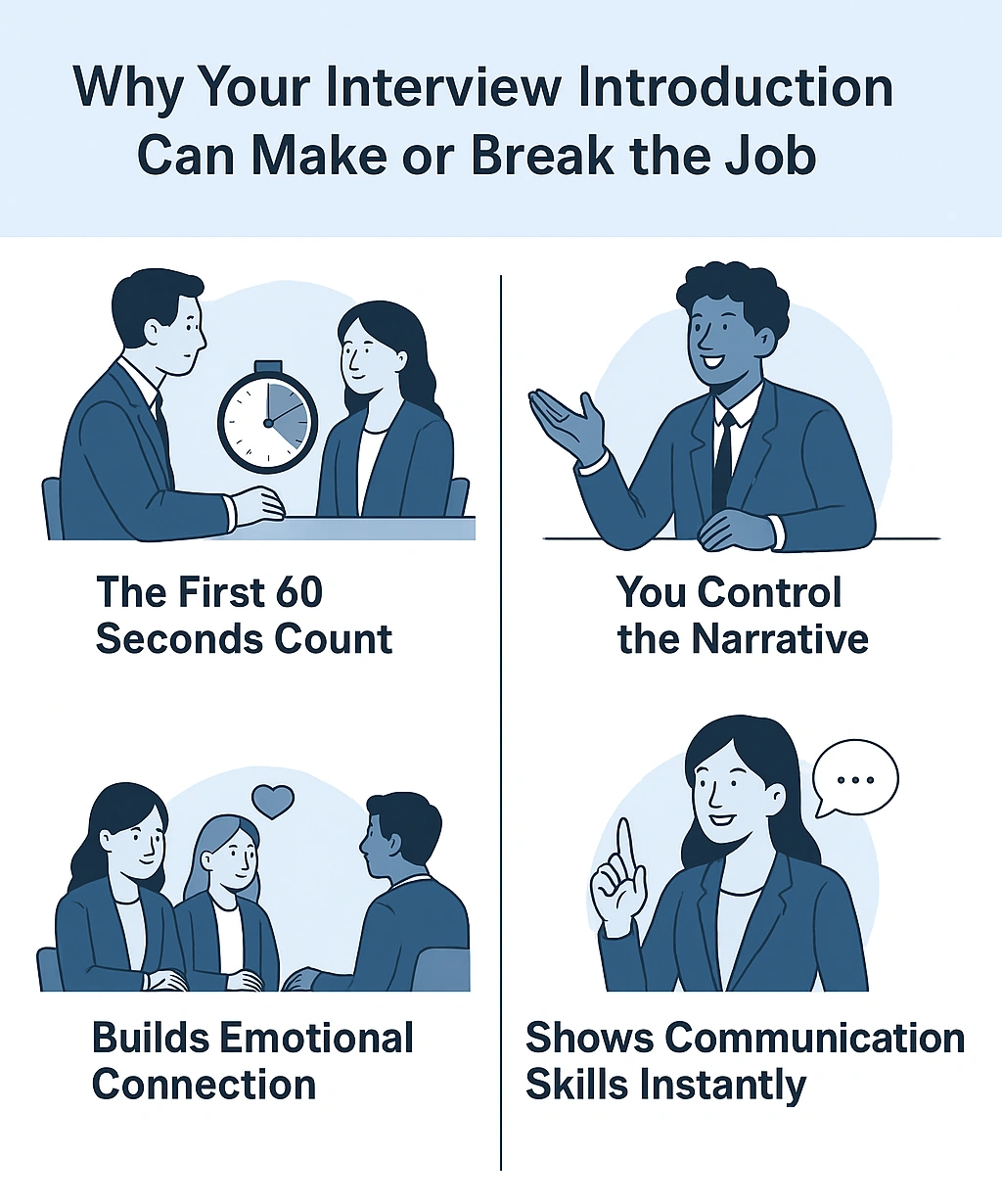 Every leading authority on interviews is clear: Your initial “Tell me about yourself” answer should last no more than 2 minutes. Most recommend aiming for 60-90 seconds for an in-person or phone screen response.
 In tech, personal projects, open-source work, or passion-driven learning are not just resume padding—they’re often valued as highly as paid experience. Companies want to see initiative, curiosity, self-direction, and a desire to keep up with evolving technologies.
How to talk about a personal project:
In tech, personal projects, open-source work, or passion-driven learning are not just resume padding—they’re often valued as highly as paid experience. Companies want to see initiative, curiosity, self-direction, and a desire to keep up with evolving technologies.
How to talk about a personal project: