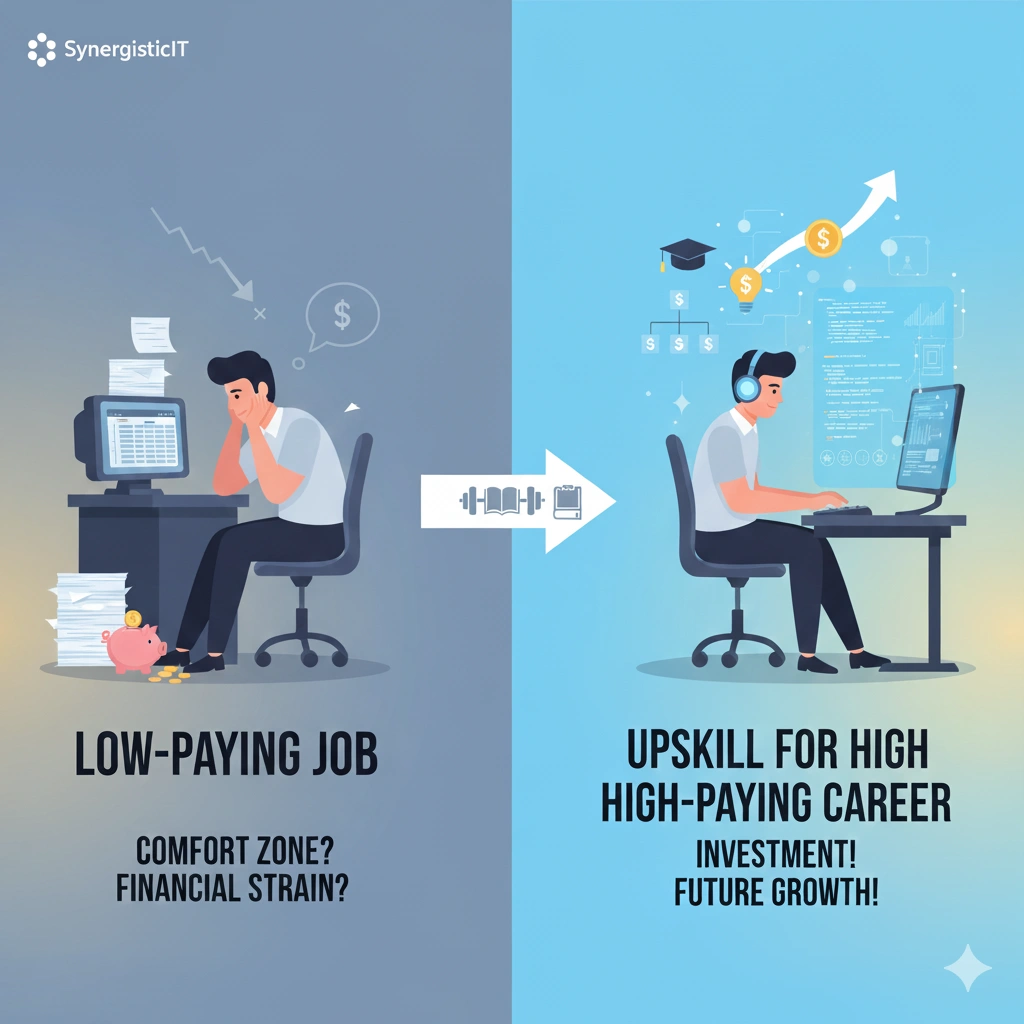
Continue in a Low-Paying Job or Upskill for a Higher-Paying Career?
Many recent college graduates — particularly those with in-demand degrees such as Computer Science — quickly find themselves facing a critical crossroads: Should you stay in a low-paying, non-tech job, or take time to upskill and pursue a higher-paying, more fulfilling career, often in technology? This decision is especially acute in today’s uncertain employment market, shaped by rapid advances in artificial intelligence (AI), shifting employer demands, and economic headwinds. For computer science (CS) graduates working outside the tech sector or stuck in low-paying roles, this is not just an abstract question; it has a tangible impact on lifetime earnings, career satisfaction, and professional growth.
Defining Low-Paying and High-Paying Jobs: Context and Thresholds
What is a Low-Paying Job?
Broadly, a low-paying job is any role that offers wages noticeably below the national median or average for full-time employment. According to the Cambridge Dictionary and Collins Dictionary, a low-paid job is one in which “your work earns you very little money,” often requiring little to no specialized training or education. The U.S. Bureau of Labor Statistics (BLS) offers concrete benchmarks: Low-paying jobs typically include roles in food service, retail, hospitality, basic clerical work, and manual labor, with average annual salaries ranging from $22,000 to $35,000.
In the U.S., the median annual wage for all occupations is around $46,310. Many common low-paying jobs — such as retail salespersons, fast food workers, cooks, and cashiers — fall well below this level, often paying $25,000–$35,000 per year or even less depending on location and hours.
Key Characteristics of Low-Paying Jobs:
Low educational requirement: High school diploma or less
Routine, repetitive tasks
Limited career progression
Vulnerability to automation and economic shifts
Hourly or irregular schedules
Lack of strong benefits (health insurance, retirement, etc.)
Despite their vital role in society, these jobs seldom leverage the specialized skills, capacity for advancement, or earning potential associated with college degrees, particularly in STEM fields.
What is a High-Paying Job?
In contrast, a high-paying job is defined as one that offers a salary significantly above the national median, often at or above $75,000 annually and sometimes much more. These roles typically require specialized knowledge, technical skills, and higher education or certifications. According to the Cambridge Dictionary, a high-paying job is “work for which people earn a lot of money,” often conferring substantial benefits, stability, and respect.
Characteristics and Examples of High-Paying Jobs:
Specialized skill set: Advanced education (bachelor’s, master’s, or beyond), certifications, or technical training
Strategic or technical duties: In software engineering, data science, finance, medicine, or law
Potential for growth: Clear career ladders, advancement opportunities
Superior benefits and stability: Retirement, healthcare, flexible schedules
Typical salary ranges: From $75,000 to $200,000+, depending on experience, location, and sector
Tech Roles as High-Paying Careers
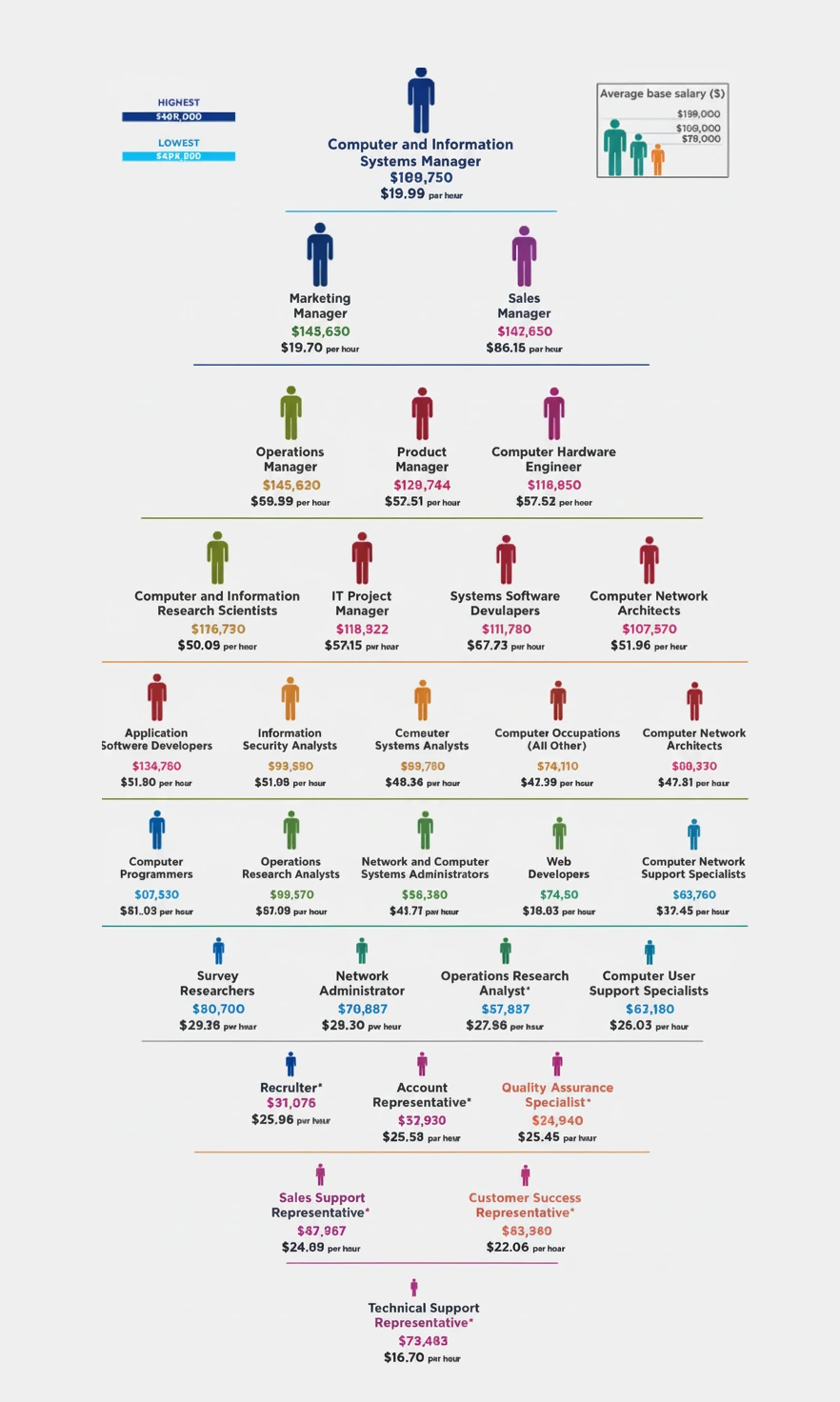
Many of the top high-paying jobs in 2025 are found in information technology, data science, artificial intelligence, and cloud computing. For example, entry-level software engineers in the U.S. today earn a median salary of around $83,000, with experienced professionals making significantly more.
Why a Computer Science Graduate in a Low-Paying, Non-Tech Role is Underutilizing Their Degree
The Lost Opportunity CostA computer science degree is one of the most in-demand credentials in the global labor market. It signals strong analytical ability, programming skills, and an aptitude for solving complex problems — precisely the attributes sought by employers in tech and other emerging fields. When a CS graduate takes or remains in a low-paying, non-technical job, they are not just earning less; they are squandering years of academic investment, missing out on valuable experience, and stalling career momentum.
Recent reports highlight this disconnect:
IT and computer science jobs, while sometimes affected by hiring cycles, still offer many of the top-earning opportunities for new graduates, with entry salaries 2–4x those of low-paying generalist roles.
Non-tech jobs accessible to CS majors (e.g., technical writing, business analysis, support) typically offer modest salaries, often $40,000–$60,000 at best, far below what technical roles provide and less likely to tap into the full skill set developed in a CS curriculum.
Lack of relevant professional experience can eventually “rust” technical skills, making re-entry into high-paying tech roles more challenging as time passes.
As one Reddit user notes, “Technical writing might be another option [for CS grads], but does technical writing pay as much as SWE [software engineering] roles? … Usually no. That being said, it’s still a technical position and is important. No shame in going that route if you want.” This captures a reality: while non-tech jobs might provide employment, they rarely maximize your earning potential or leverage your real training.
Salary Comparison: Non-Tech vs. Tech Salaries for CS Graduates
Role/Area
Typical Salary (U.S., 2025)
Technical Skill Requirements
Degree Utilization
Fast Food Worker
$25,000–$31,000
None/Minimal
None
Retail Sales Associate
$28,000–$36,000
None/Minimal
None
Non-Tech Office Admin
$35,000–$45,000
Basic Digital Literacy
Minimal
Technical Writer (Entry, Non-SWE)
$48,000–$60,000
Moderate (Writing, Light Technical)
Partial
Business Analyst (Non-Tech)
$52,000–$66,000
Analytical, Soft Skills
Partial
Entry-Level Software Engineer
$76,000–$90,000+
High (Java, Python, Algorithms, etc.)
Substantial
Data Scientist
$100,000–$140,000+
High (Statistics, ML, Python, etc.)
Full
Full-Stack Developer
$85,000–$125,000+
High (Java, JS, Cloud, DevOps)
Full
Detailed Analysis: Even a junior software engineer salary is at least 1.5–2x that of most entry-level non-tech office roles. Data science or cloud engineering positions frequently command salaries in the six-figure range. Compare this to the median pay for administrative or support roles, which hovers at $35,000–$50,000, and the financial incentive to upskill is overwhelming.
The Power of Upskilling: How and Why It Unlocks Greater Salaries
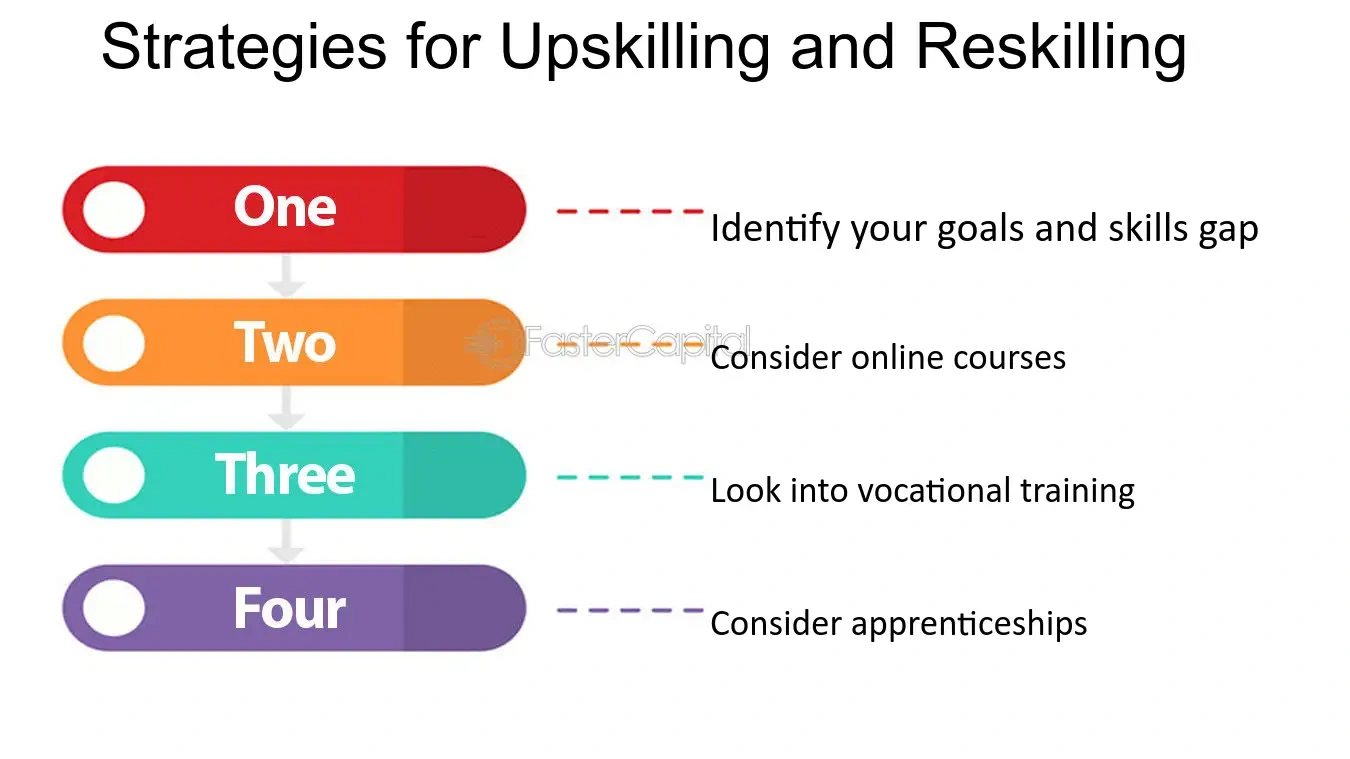
What is Upskilling (and Reskilling) and Why Does it Matter?Upskilling refers to acquiring advanced skills beyond your current role, to increase your market value and adaptability in a changing labor market. Closely related, reskilling means learning new skills that allow you to move into an entirely different career path, often in response to shifts brought by AI and automation.
Contemporary Drivers for Upskilling:
AI and Automation Pressure: 70% of the skills used today are expected to evolve by 2030.
Skills Shortages: 52% of companies now consider digital skills as the most critical hiring criteria, and 55% report difficulty finding such candidates.
Corporate Adaptation: 94% of business leaders expect employees to upgrade their skills by 2026.
Direct Salary Impact: The Georgetown Center on Education and the Workforce found that STEM and middle-skill training can deliver a salary boost of up to 38% or more. Amazon’s research quantifies the potential: workers who upskill see average raises of $8,000/year, with some post-upskilling salaries rising by 2–3x.
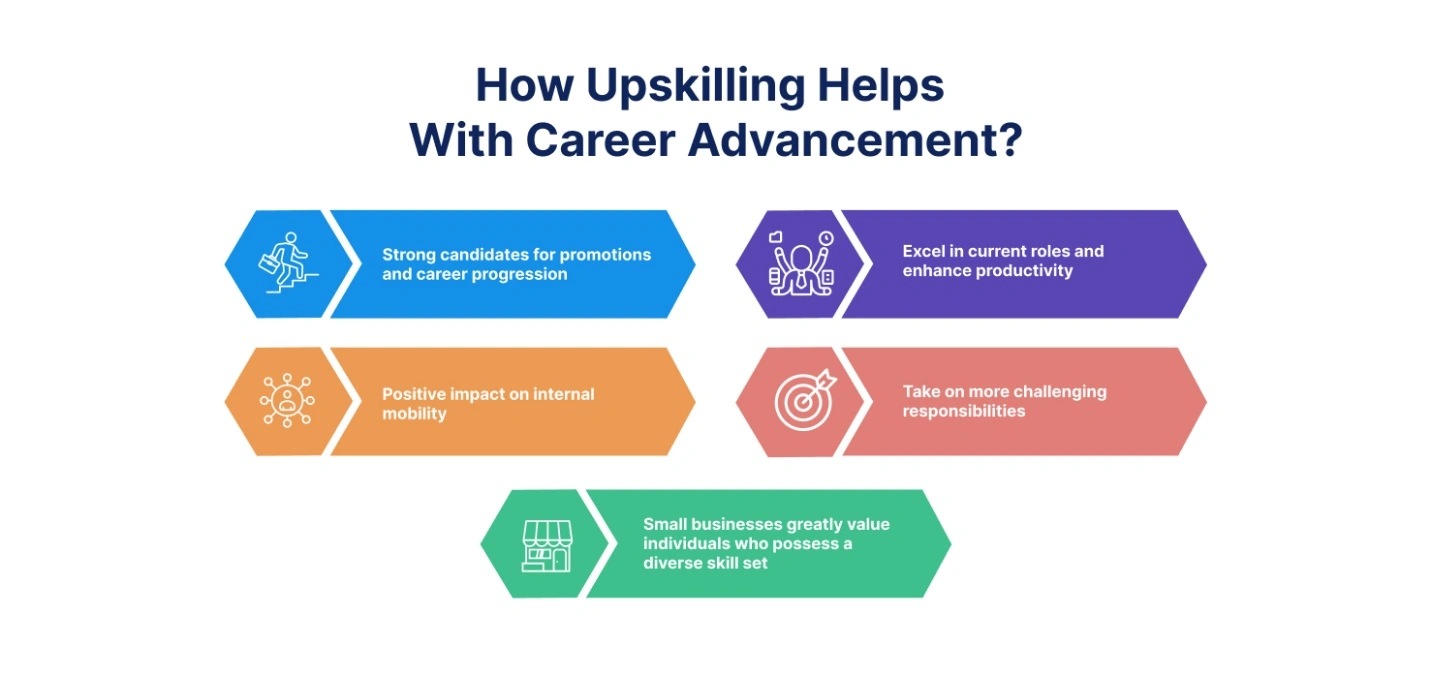
Upskilling is not optional in the modern workplace; it is an imperative for career advancement and income growth.
Upskilling vs. Staying in a Low-Paying Job: The Financial Case
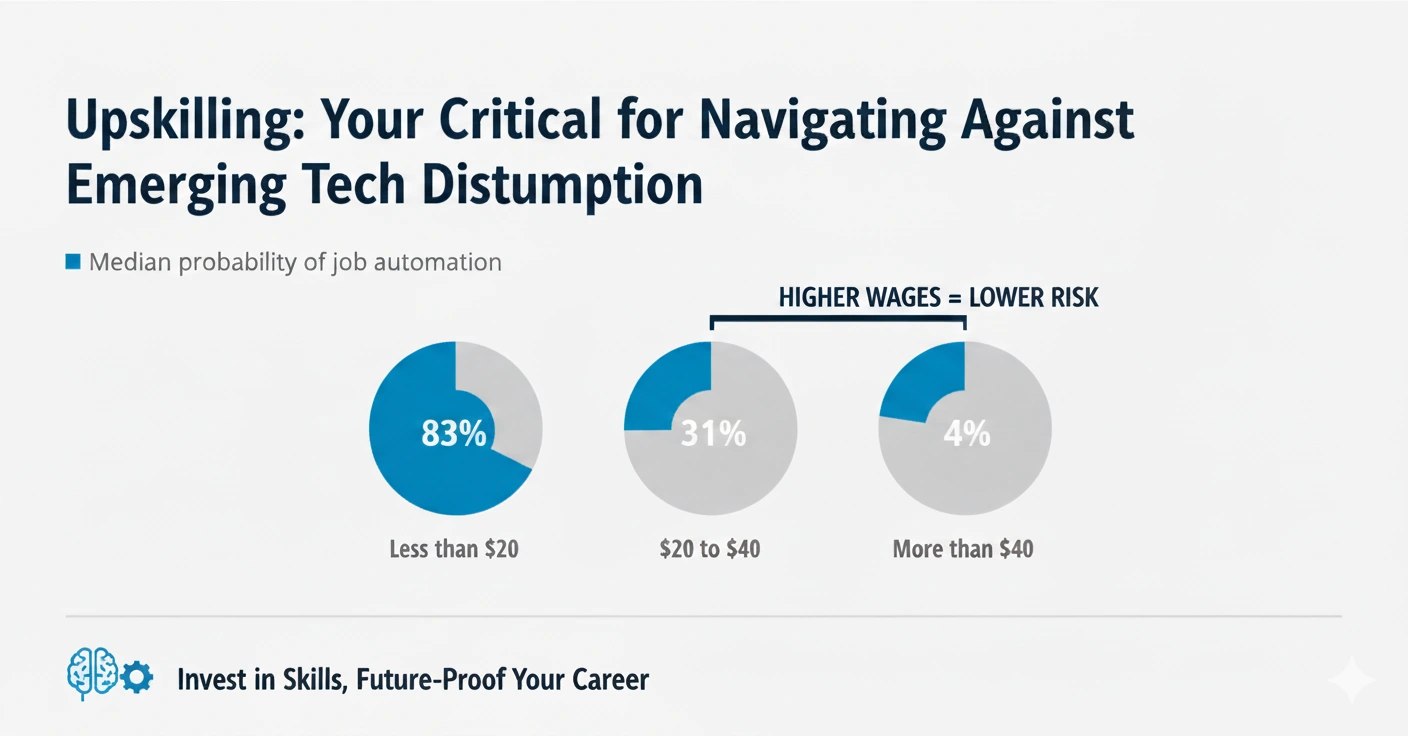
Remaining in a low-paying job may seem safe in the short-term but is likely to reduce overall life earnings and job satisfaction. A recent analysis shows that staying static often leads to increased vulnerability to layoffs (especially as automation threatens many low-skilled jobs) and offers little chance for real raises beyond meager inflation adjustments.
Calculating the Difference in Lifetime Earnings
Let’s consider two hypothetical CS graduates:
Alex: Remains in a $32,000/year retail job for 10 years with a 2% annual raise.
Blake: Invests 6 months to upskill, enters tech at $82,000 with 5% raises.
Year
Alex (Low-Paying)
Blake (Upskilled)
1
$32,000
$41,000 (half-year upskilling) + $41,000 (half-year in tech)
2
$32,640
$82,000
3
$33,293
$86,100
…
…
…
10
$38,940
$128,000
Cumulative 10-Year Earnings:
Alex: ~$350,000
Blake: ~$930,000 (assuming steady progression in tech)
Essentially, Blake’s decision to upskill and pivot to a tech role results in nearly triple the income over a decade, even accounting for months spent in training.
Impact on Job Security and FulfillmentUpskilling not only boosts earnings, but also reduces risk in an AI-driven market. High-paying, specialized roles are less likely to be automated, tend to have stronger job ladders, and offer superior work-life benefits. Furthermore, tech roles are widely rated as more fulfilling due to their complex, creative challenges and real-world impact.
Real-Life Stories: From Low-Paying Work to Tech Success
Nothing clarifies the power of upskilling more than the real stories of individuals who made the leap. Their journeys reflect both the possibilities and the practical steps required for advancement.
X: Sales to Data AnalyticsBackground: Javier worked in sales, feeling stagnant and underpaid.
Action: He completed a data analytics bootcamp, actively participated in networking events, and contributed to real-world analytics projects.
Result: Javier found employment as a data analyst, again earning at least twice his previous wage and joining a profession in high demand.
Y: Teacher to Software DeveloperBackground: Priya taught for several years but wanted a bigger impact and higher earning opportunities.
Action: She entered a reputable coding bootcamp, committed to self-study, and built foundational software projects.
Result: Priya transitioned into software development, achieving a substantially higher salary, job satisfaction, and long-term career prospects.
Other Inspiring Career-Change Stories
A former operations manager became a project manager for tech projects after learning project management and digital skills.
One woman transitioned from burnout in healthcare to a no-code tech entrepreneur, leveraging new platforms and remote work.
These stories, echoed by countless others, confirm that the economic and personal returns of upskilling are real, quantifiable, and attainable with the right support.
Why Choose Structured Upskilling and Placement? The SynergisticIT Advantage
Addressing the Modern Employment Challenge
Despite a CS degree’s value, many new grads and young professionals struggle to land high-paying tech roles directly out of college. Reasons include:
Outdated technical knowledge or lack of practical, in-demand skills (cloud, DevOps, advanced frameworks)
Weak interview preparation; unfamiliarity with the specific expectations of top tech firms
Resumes that do not highlight job-ready project experience
Insufficient access to recruiters and hiring networks
This is where well-designed, modern job placement and upskilling programs shine — and where SynergisticIT stands out.
SynergisticIT: Not Just an upskilling Program — A Pathway to Tech SuccessSynergisticIT’s Job Placement Program is built on a comprehensive, hands-on approach that shifts candidates from low-paying or stagnant roles to lucrative, high-growth tech positions. Unlike generic staffing agencies or standard bootcamps, SynergisticIT goes beyond skills training to include resume marketing, interview mastery, client networking, and hand-holding until you get the offer.Key Features:
Immersive, real-world upskilling in the latest tech stacks: Java, Data Science, AWS, MERN, DevOps, and more
Extensive interview preparation: Covers coding, behavioral, scenario-based challenges, and access to 5,000+ interview questions from real clients (see their 3000 Interview Questions Collection)
Certification support: Oracle, AWS, Microsoft (Azure), IBM, and others — preparation is included at no additional cost, unlike most bootcamps and universities
Resume marketing: Active marketing to a database of more than 24,000 tech clients, including Fortune 500 and high-growth startups
Personalized attention: Small batches, one-on-one mentorship, and direct project work
Job placement guarantee: No candidate is left behind; you get continual support until you’re hired
Better ROI: Alumni report higher placement and starting salaries than peer programs; outcomes often outstrip returns from a second advanced degree
Outcomes & Testimonials
Thousands have launched successful tech careers through SynergisticIT, with placements in companies like Apple, Google, Wells Fargo, Bank of America, PayPal, and more. Alumni share feedback about the value of real-world projects, personalized instruction, and the persistence of SynergisticIT’s placement advisors.
“I had a great experience with SynergisticIT. It was hard work, but the program got me into the job field I wanted to be in at a higher pay rate than I expected. … Real-time projects, mock interview sessions, and placement support made the difference.” — Anonymous, Senior Data Scientist, 2020
Dedicated Placement Tracks: Java, Data Science, and AI
Java Full Stack Placement Program: End-to-end mastery of Java, MERN, cloud, DevOps. Candidates gain hands-on project experience, certification prep, and direct job marketing. Average graduate salaries: $90,000–$150,000+ in 2025.
Data Science Placement Program: Training in machine learning, Python, cloud, predictive analytics. Graduates move into data-driven tech roles with high earning potential — often surpassing $100,000 within 1–2 years of employment.
SynergisticIT YouTube Channel: Event highlights, career tips, real-world project samples, and motivational/inspirational content specific to jobseekers.
Context: This table underscores SynergisticIT’s holistic, success-oriented approach: candidates are not only trained in the most current, relevant tech stacks but also receive extensive support in soft skills, job search strategy, and employer matching. No one is left to “sink or swim” alone, as is common elsewhere.
Addressing Counterpoints and Concerns
Is Upfront Investment in Upskilling Worth It?
Some candidates hesitate to step away from a low-paying job (however unsatisfying) to invest time and/or money into upskilling, fearing risk or lost income. Industry data and alumni stories reveal, however, that even with a 3–6 month investment, the break-even point is rapid (often within a year), and the opportunity cost of inaction is far greater.
Are Upskilling Programs Like SynergisticIT’s a “Guarantee” of a Job?
No ethical program can promise employment in exchange for tuition alone. Instead, reputable programs combine intensive skill development, real-world project work, preparation for industry-recognized certifications, and active job search support to maximize placements. Reviews and alumni result for SynergisticIT show that, with commitment, even jobseekers with little prior experience succeed in securing roles at top firms.
The Broader Labor Market: Upskilling as a Strategy for Staying Relevant
Recent headlines from publications like USA Today and Forbes emphasize that staying static is no longer an option in the age of AI:
“AI is changing the workplace — fast. Even top performers could get left behind if they don’t keep up. That might mean learning new AI tools, developing different skill sets, or even pivoting to a new role altogether.” — USA Today, July 2025
“Upskilling gives you leverage. Learning high-demand skills can increase your earning potential by thousands; upskilling could result in a raise of $8,000 per year on average [and much more in tech].” — Forbes, March 2025
AI is also reducing the number of entry-level tech roles available to recent college grads, shifting the value even further toward candidates who proactively demonstrate up-to-date, in-demand skills.
Adaptability and rapid, focused learning — the kind encouraged in immersive upskilling programs — is now as important as formal credentials.
Conclusion: Seize the Advantage — A Call to Action
If you are a computer science graduate, or anyone with untapped technical potential, do not settle for less than you’re worth. The data, stories, and expert consensus are clear: taking time to upskill, especially through a program that couples technical rigor with robust job placement support, is the fastest, most reliable path to doubling your current salary, securing career stability, and achieving personal fulfillment.
While economic challenges and AI-driven change complicate the path to high-paying careers, they also expand opportunities for those willing to invest in themselves, adapt, and partner with expert accelerators like SynergisticIT. You owe it to yourself and your future to step out of a low-paying routine, maximize the value of your degree, and build the skills and connections that enable your career to thrive.
Ready to Upskill and Get Hired? Explore SynergisticIT’s Career Launch Resources
Final Thought
Whether you’re stuck in a low-wage job out of habit, fear, or inertia, or ready to take your CS education to the next level, remember: the biggest risk in your career is often standing still. Upskill, pivot, and pursue your true earning — and fulfillment — potential. Your future self will thank you.

 Many recent college graduates — particularly those with in-demand degrees such as Computer Science — quickly find themselves facing a critical crossroads: Should you stay in a low-paying, non-tech job, or take time to upskill and pursue a higher-paying, more fulfilling career, often in technology? This decision is especially acute in today’s uncertain employment market, shaped by rapid advances in artificial intelligence (AI), shifting employer demands, and economic headwinds. For computer science (CS) graduates working outside the tech sector or stuck in low-paying roles, this is not just an abstract question; it has a tangible impact on lifetime earnings, career satisfaction, and professional growth.
 Contemporary Drivers for Upskilling:
 SynergisticIT: Not Just an upskilling Program — A Pathway to Tech Success
SynergisticIT’s Job Placement Program is built on a comprehensive, hands-on approach that shifts candidates from low-paying or stagnant roles to lucrative, high-growth tech positions. Unlike generic staffing agencies or standard bootcamps, SynergisticIT goes beyond skills training to include resume marketing, interview mastery, client networking, and hand-holding until you get the offer.
Key Features:
SynergisticIT: Not Just an upskilling Program — A Pathway to Tech Success
SynergisticIT’s Job Placement Program is built on a comprehensive, hands-on approach that shifts candidates from low-paying or stagnant roles to lucrative, high-growth tech positions. Unlike generic staffing agencies or standard bootcamps, SynergisticIT goes beyond skills training to include resume marketing, interview mastery, client networking, and hand-holding until you get the offer.
Key Features: